

Por: Treasury Commerce
14/10/2022
Overview: Since Russia’s unjustified and unprovoked invasion of Ukraine in February 2022, the United States has worked with allies and partners around the world to impose costs on Russia for its war ofaggression. The Department of the Treasury’s Ofice of Foreign Assets Control (OFAC), the Department of Commerce’s Bureau of Industry and Security (BIS), and the Department of State are issuing this alert to inform the public of the impact of sanctions and export control restrictions targeting Russia’s defense capabilities and warn of the risks of supporting Russia’s military-industrial complex.
Summary of actions taken in response to Russia’s unjust war: In response to Russia’s attack on Ukraine, OFAC, BIS, and the Department of State, along with our foreign partners, have imposed an unprecedented range of sanctions and export controls.
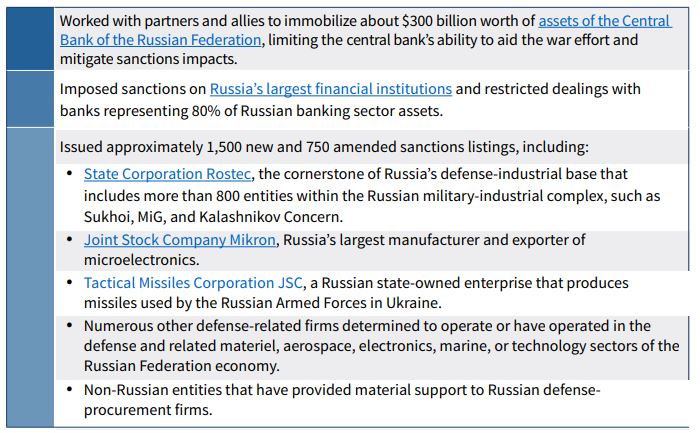
Since February 2022, OFAC and the Department of State have:
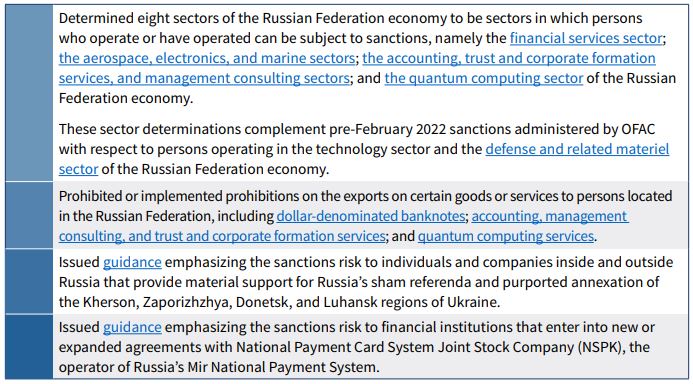
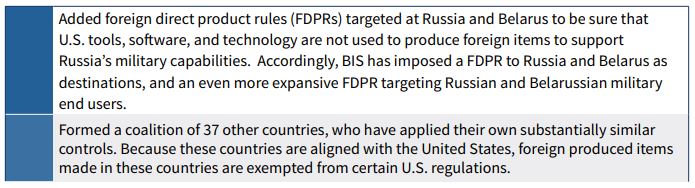
Since February 2022, BIS has focused on degrading Russia’s military capabilities and has:

Strategic Intent and Impact of Our Actions:
The strategic intent of our actions is to degrade Russia’s ability to wage its unjust war against Ukraine and prevent Russia from projecting military force beyond its borders. Sanctions and export controls are having significant and long-lasting consequences on Russia’s defense industrial base, which relies extensively on foreign-sourced items. By restricting Russia’s access to advanced goods, technology and services, the United States and our allies have degraded the Russian defense industry’s ability to replace weapons destroyed in the war, including over 6,000 pieces of military equipment, such as tanks, armored personnel carriers, and infantry fighting vehicles.
For example, one of Russia’s major tank producers, Uralvagonzavod, was reported to be due to a lack of foreign components and has had to furlough employees. Major supply shortages for Russian forces in Ukraine, in part because of sanctions and export controls, are forcing Russia to turn to less technologically advanced countries like Iran and North Korea for supplies and equipment. Russia’s defense industry is reliant on imported microelectronics. Since imposition of U.S. and allied
restrictions, semiconductor imports from all global sources, the lifeblood of Russia’s weaponry, have dropped on a sustained basis over time of approximately 70 percent. Russian hypersonic ballistic missile production has nearly ceased due to the lack of necessary semiconductors used in the manufacturing process. The production of cars fell by three-quarters compared to last year, indicating that critical advanced microchips for civilian vehicles are being redirected for military use.
The Russian military is reportedly cannibalizing chips from dishwashers and refrigerators to fix their military hardware, because they have run out of emiconductors. Russia’s military aviation program no longer benefits from the revenue and resupply provided by aviation trade. Russian media reports that production of its next-generation airborne early warning and control (AEW&C) aircraf has stalled due to lack of foreign components, including semiconductors. Mechanical plants, including those producing surface-to-air missiles (SAMs), have been shut down. Russia has begun using Soviet-era defense stocks as its own companies are targeted by our measures. As flagged in recent guidance , OFAC is also prepared to use its broad targeting authorities against non-U.S. persons that provide ammunition or other support to the Russian Federation’s military industrial complex, as well as private military companies (PMCs) or paramilitary groups articipating
in or otherwise supporting the Russian Federation’s unlawful and unjustified attack on Ukraine. OFAC will continue to target Russia’s eforts to resupply its weapons and sustain its war of aggression against Ukraine, including any foreign persons who assist the Russian Federation in those eforts.
While Russia has benefited from high energy prices and a store of foreign exchange reserves, the U.S. Government has worked with partners and allies to immobilize about $300 billion worth of assets of the Central Bank of the Russian Federation, limiting the central bank’s ability to aid the war efort and mitigate sanctions impacts. Sanctioned Russian oligarchs and financial institutions have been forced to divest from long- held assets outside Russia. Sanctions on Russia’s financial leadership have prompted banks in several countries to curtail ties with the Russian financial sector, for example by suspending use of Russia’s Mir payment system. From a macroeconomic perspective, Putin’s war has resulted in a sharp economic contraction for Russia and will drag on Russia’s economy for years to come. The International Monetary Fund (IMF), World Bank, and Organisation for Economic Co-operation and Development (OECD) forecasters expect
Russia’s economy to contract between 3.4 and 5.5 percent in 2022 and between 2.3 and 4.5 percent in 2023, roughly in line with private sector forecasts. Longer term, potential growth is expected to be very low, as Russia has shifed spending from investment to its military, lost access to key technologies, and diminished its human capital due to brain drain, while its companies have been severed from developed financial markets. Amid the impact of sanctions, Putin’s choices, and the weak outlook, multinational corporations have fled Putin’s Russia. According to estimates, over 1,000 global companies have curtailed or suspended operations in Russia. Academic and private sector analysts have estimated that that Russia’s imports from the rest of the world fell around 30% in the wake of Russia’s attack on Ukraine, and remain below levels observed prior to Putin’s invasion.
Sanctions Evasion
To overcome the impacts on its military supply chain and to illicitly procure foreign technology, Russia is attempting to evade U.S. and partner sanctions and export controls using a range of techniques, including front companies and fraudulent end-user licenses. Existing sanctions authorities allow OFAC and the Department of State to impose sanctions on deceptive or structured transactions or dealings to circumvent any United States sanctions, as well as on persons that materially assist, sponsor, or provide financial, material, or technological support for, or goods or services to or in support of, sanctioned persons or sanctionable activities. OFAC and the Department of State have and will continue to use their authorities against persons inside and outside Russia that engage in sanctions evasion or circumvention. For example, in March 2022, the Department of State designated a Russian defense-related firm, Radioavtomatika, due to its role as an entity pecializing in the procurement of foreign items for Russia’s military and defense industry. Since March, Radioavtomatika has attempted to leverage front companies and intermediaries in Uzbekistan, Armenia, and the People’s Republic of China to continue its importation of critical technologies. In June 2022, the Department of State designated an Uzbekistan-based entity that actively supported Radioavtomatika in its eforts to evade U.S. sanctions. In September 2022, OFAC designated individuals, front companies, and foreign intermediaries associated with a Radioavtomatika procurement network set up to procure foreign items for Russia’s defense industry. These designations should serve as a warning that those who support sanctioned Russian persons risk being sanctioned themselves.
Similarly, in June 2022, OFAC designated three Russian individuals and one entity based in Asia that were part of a covert procurement network linked to the Russian Federal Security Service (FSB). This FSB-linked network covertly procured U.S., Japanese, and European components for Russia’s defenseindustrial base through various foreign countries and bank accounts. To assist industry identifying export control evasion, in June 2022 the Financial Crimes Enforcement Network (FinCEN) and BIS issued a joint alert that provides financial institutions with an overview of BIS’s current export restrictions; a list of commodities of concern for possible export control evasion; and select transactional and behavioral red flags to assist financial institutions in identifying suspicious transactions relating to possible export control evasion. Additional Information For additional information about sanctions and export controls imposed in response to Russia’s unjust
war against Ukraine, please visit OFAC’s website , BIS’s website or State’s page on Ukraine and Russia Sanctions.
https://home.treasury.gov/system/files/126/20221014_russia_alert.pdf